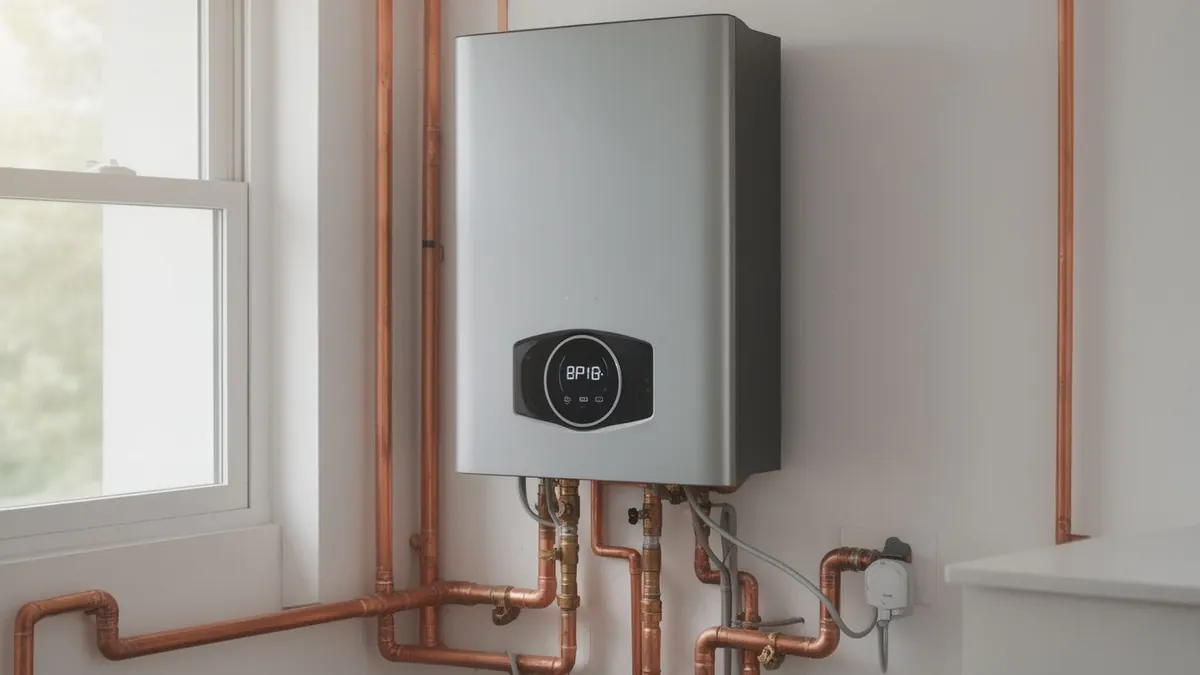
Both types work well when they're sized and installed correctly. The right choice depends on how much hot water you use, your budget, your gas supply and how long you plan to stay.
Side-by-side
| Tank | Tankless | |
|---|---|---|
| Installed cost | $900 – $2,500 | $1,400 – $4,000 |
| Lifespan | About 8 – 12 years | About 15 – 20 years |
| Hot water supply | Limited to tank capacity | Continuous, limited by flow rate |
| Energy use | Standby heat loss | Heats on demand |
| Maintenance | Flush annually | Descale about annually |
| Space | Large footprint | Wall-mounted, compact |
| Install complexity | Simple swap | May need gas line, venting, electrical |
When tank makes more sense
- You want a smaller upfront cost or a quick like-for-like replacement
- Your gas line or venting would need expensive upgrades for tankless
- You may sell the home in the next few years
When tankless makes more sense
- You run out of hot water often
- You plan to stay for many years, so the longer life pays back
- You need the floor space
Colorado factors
- Cold inlet water in winter means tankless units must be sized for a bigger temperature rise.
- Altitude can reduce gas output; choose models rated for your elevation — see water heaters at altitude.
- Gas line capacity: tankless units need much more gas at full fire, which can require a larger line from the meter.
Get a professional sizing
A plumber can check your peak hot water demand, gas line capacity and venting and give you prices for both options. See water heater replacement.
Frequently asked questions
Does a tankless water heater lower utility bills?
It reduces standby losses, so many households use less energy, but the payback depends on usage and the higher upfront cost.
Can tankless run two showers at once?
Yes, if it's sized for that flow at your winter water temperature and elevation.
Is a heat pump water heater an option in Colorado?
Yes. Hybrid heat pump units are very efficient electric options but need space and airflow, and work less efficiently in cold spaces.